

What mindset flexibility looks like on a Tuesday afternoon.
It’s 2.4Opm. You’ve just finished a tense conversation with a senior stakeholder pushing for certainty on a project that still has too many unknowns. Ten minutes later, you’re in a team meeting trying to prioritize competing demands. Before the hour is out, someone escalates a problem that doesn’t have a clean solution.
Sound familiar? It’s a daily reality most leaders face, and having a broad mindset range can change the outcomes of all three conversations.
Operating from a narrow range of mindsets – relying heavily on existing subject-matter expertise (detail focus, past practices) or achievement (immediate results, known solutions) – often keeps a leader in a mode of reaching for clear answers and existing playbooks. In the scenario above, they seek clarity where there isn’t any yet, treat the ambiguous stakeholder conversation the same way as the operational discussion. The intent is good – move forward, be useful – but the approach doesn’t flex, because each situation is filtered through the same lens.
Broader mindset range allows a leader to toggle between structured execution, experimentation, iteration, and larger systemic perspectives.
So what does this mean in practice?
Let's look at how that same Tuesday afternoon could unfold for a leader:
- In the stakeholder conversation, they recognise the adaptive challenge of the project. Instead of over-promising they surface the tensions, name what’s unclear and focus on the next useful step.
- In the team meeting, they shift into into a more structured, process-focused mode to help the group make decisions.
- When the unexpected problem lands, they pause long enough to ask ‘What kind of challenge is this?’ before jumping to solutions.
That is what mindset flexibility looks like on-the-job. Importantly, developing range is not about having a ‘better’ mindset, it's about developing the ability to see and respond through more lenses, and move between them intentionally.
In complex environments, the cost of limited range is often quiet but costly. Projects stay stuck, conversations become repetitive, and leaders burn energy trying to create certainty in situations that can’t offer it yet. Over time, the organization’s ability to adapt slows down.
The opportunity, however, is enormous. When leaders develop the ability to gauge the nature of the challenges in front of them and adjust accordingly, they waste less effort and create more forward movement. Development that builds this mindset range doesn’t just make individuals more effective – it increases the organization's overall capacity to deal with complexity as it appears.
A question to sit with this week - In the middle of a messy Tuesday afternoon, how often do you intentionally change the lens you're looking at challenges through? And what impact would building this capacity in leaders in your organization have on critical outcomes?
Leadership mindsets
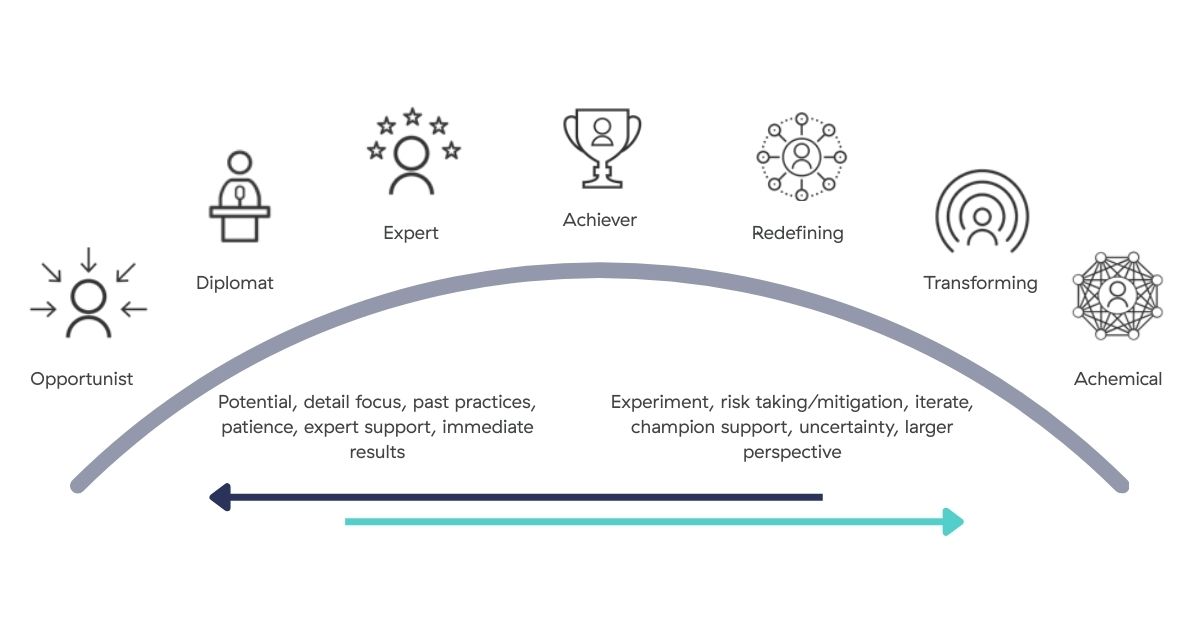
Measuring and building mindset range
Over the past six years Adeption has worked with over 12,OOO leaders globally to unlock the power of building mindset capacity at scale.
Grounded in 4O+ years of adult development research, the Leadership Mindset Indicator (LMI) measures how leaders process complex challenges, balance competing priorities, and adapt under pressure. It gives your people clear insight into their current thinking patterns – and practical ways to expand them.
- Fast – 15-min assessment + 15-min digital debrief option.
- Scalable – AI-powered for personalized development organization-wide.
- Actionable – Immediate clarity into mindset range, blind spots, and practical growth.
- Flexible – Stand-alone, embedded in programs, or paired with coaching.
Explore our learnings from working with leaders and the LMI in the position paper:
By Nick Petrie, Jan Rybeck, and Carl Sanders-Edwards