

Published 3O September 2O26
5 mins read time
AUTHORS
Carl Sander-Edwards
Co-founder and CEO, Adeption
Lettie Dalton
Chief Delivery Officer, Adeption
Much of today’s C-suite conversation frames AI transformation as a technology race – where the company with the cleanest data, most powerful models, and latest skills wins. Yet history shows that the biggest gains from transformative technologies come not from doing the same things faster, but from rethinking what the technology makes possible.
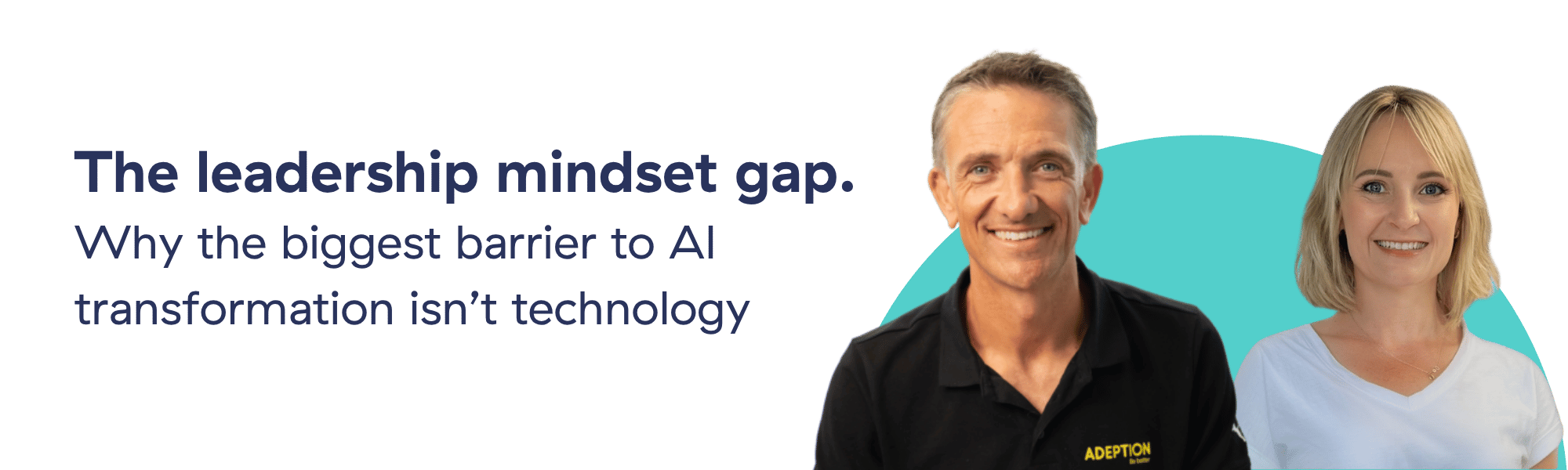
In their latest position paper, The Leadership Mindset Gap, Adeption’s Carl Sanders-Edwards and Lettie Dalton address a challenge unfolding across almost every industry: why so many organizations are seeing only incremental speed gains rather than capturing true, systemic value from AI.
The role of psychological agility in the AI era
Adeption’s research and work with forward thinking organizations indicate that success in the AI age relies less on technology and tools, and far more on the psychological agility of leaders. The mindsets that served organizations well in the past were built for a very different landscape, leaving many teams unable to realize the full benefits of modern technology right now.
This shift stretches far beyond executive teams – it impacts every person in an organization, regardless of title. Navigating it well comes down to building mindset range: the ability to flex how we think and see the world, balancing the operational discipline needed for current performance with the systemic curiosity required to redesign how value is created.
A two-part approach to building mindset range
Rather than treating AI rollouts and capability building as separate workstreams, the paper outlines a practical, two-part framework for leaders:
- Awareness tools: Using light-touch assessments and workshops to spot default habits and legacy mental models.
- Live transformation: Leveraging active AI initiatives as the core engine for leadership growth in the flow of work.
The paper includes a speculative look into the ‘agentic enterprise,’ exploring how leadership capacity and human judgment must evolve when daily operations run autonomously. Ultimately, Carl and Lettie make a case that expanding how we think is the key to building organizations where human ingenuity and artificial intelligence sharpen one another to unlock meaningful value.
Download The Leadership Mindset Gap Position Paper.
Frequently Asked Questions
What is the biggest barrier to AI transformation in organizations?
This paper argues that the primary bottleneck isn’t technology or technical skills, but a leadership mindset gap. While legacy mindsets focus on using AI to automate existing workflows for incremental speed, capturing true value requires psychological agility to redesign redesign how work gets done.
What is ‘mindset range’ in leadership?
Mindset range is the capacity for leaders to flex how they think about and approach challenges and perceive complexity. Developing mindset range helps leaders balance the operational discipline needed for performance with the systemic curiosity needed to innovate and navigate AI-driven ambiguity.
How do organizations build leadership readiness for AI?
Carl and Lettie outline a two-part approach: first, creating mindset awareness via light-touch assessments and workshops; second, using active AI transformation initiatives as the hands-on arena for deliberate leadership development.
What to explore next


What mindset flexibility looks like on a Tuesday afternoon
What mindset flexibility looks like on a Tuesday afternoon. It’s 2.4Opm. You’ve just finished a tense conversation with a senior stakeholder pushing for certainty on a project that still has too many unknowns. Ten minutes later, you’re in a team meeting trying to…
About Adeption
Adeption helps organizations develop future-ready leaders at scale by turning real work into leadership development.
Our methodology combines world-class facilitation, AI-powered technology and an action focus – helping leaders rapidly grow their capacity while navigating their top leadership challenges.
Adeption partners with leading organizations around the world. Our work has received multiple Brandon Hall Group HCM Excellence Awards and recognition on Training Industry’s 2O26 Leadership Training Watch List.