
Every organizational change begins with a plan, a framework, and a set of goals. These foundations are essential – they provide the structure we need to move forward. However, organizational change and transformation is no longer an occasional initiative; it's become the permanent environment in which most leaders operate, and leaders are finding that the technical plan is just the starting point.
To explore what drives success in this landscape, we asked 1,945 leaders across 17 organizations to reflect on a time they successfully instituted a change (big or small) and analyzed the aspects of their approach they felt were effective. By mapping these data points to the Prosci ADKAR® Model, we’ve identified how leaders are expanding their reach beyond traditional information delivery to create lasting, behavioral shifts.
The complexity reality
Our wider research* into leadership challenges reveals that 62% of the hurdles leaders face today stem from complexity, ambiguity, and urgency. This confirms that in a permanent environment of change, success depends on our ability to navigate the 'grey space' where no manual exists.
Insight 1: Purpose is the essential stabilizer for high-complexity change
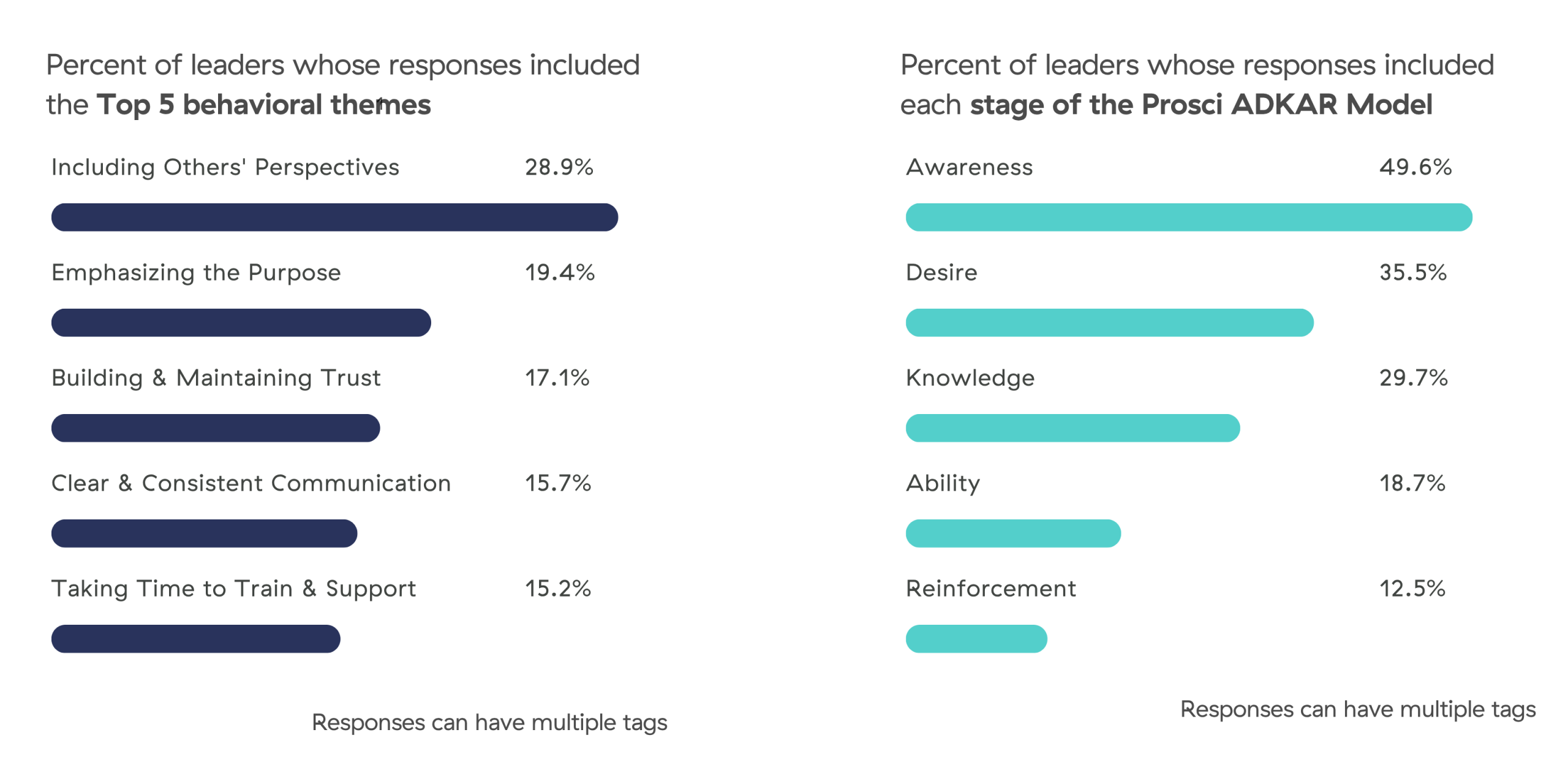
In transformation, the initial focus is often on clarity and Awareness. While it is important to communicate the logistics, our data reveals that the most effective anchor for a team is a shared sense of purpose. Among the successful leaders we studied, 19.4% highlighted Emphasizing the Purpose as a standout behavioral theme during the Awareness stage.
In high-complexity environments, purpose provides the stability needed to move forward confidently. Our analysis suggests that by authentically sharing the "why" during the initial rollout, leaders create a natural behavioral foundation for Building & Maintaining Trust (17.1%).
This link between purpose and effective planning is a hallmark of high-performing leadership; our broader research* shows that leaders who can access a wider range of leadership mindsets are 29% more likely to outline a clear strategy and purpose when planning actions.
When purpose is clear, it acts as a compass, allowing the team to navigate uncertainty and maintain momentum even when the specific path forward is still being defined.
Rule of Thumb: Get on the Balcony
To find the deeper purpose, it helps to step back from the tactical day-to-day. "Getting on the balcony" allows you to see the broader dynamics at play. It gives you the perspective needed to connect the current change to the long-term value it brings to your team and the organization.
Action: Lead with Vulnerable Transparency
In your next meeting, try expanding the conversation beyond the tactical "what." Share a personal reflection on why this change matters to you. By being transparent about your own "why," you intentionally contribute to the trust necessary for the journey ahead.
Or try the ideas in our tool People Resist Being Changed – Not Change Itself.
Insight 2: Inclusion outperforms communication 2-to-1
When we think about the Awareness stage of change, the default response is often to increase the volume of communication. However, our data reveals a more effective lever: Including Others' Perspectives and Ideas (28.95%). In fact, leaders in our study mentioned inclusion nearly twice as often as Clear Communication (15.7%).
While top-down information provides the initial spark, inclusion is what keeps the fire burning. When leaders provide the scaffolding for teams to act as active architects of change rather than passive participants, they replace simple information delivery with a shared understanding.
Our research into adult development highlights why this is so effective: 29.2% of leaders identify "Colliding Perspectives' – the exposure to new worldviews and opinions – as a primary condition for their own growth and problem-solving.
Rule of Thumb: Collaborate
With complex challenges, no one person has all the answers. Since transformation often sits in the 'cracks' between organizational structures, getting to a solution requires collective intelligence. The goal is to enlist and motivate others to help solve the problem with you.
Action: From-To exploration
An effective way to facilitate this co-creation is a simple From-To exercise. Instead of presenting a finished plan, bring your team together to explore the transition. Read more.
Insight 3: Transformation succeeds through active guidance
Change often stalls at the point where people know what to do, but haven't yet built the skill to do it. Our analysis shows that even in successful transformations, the Ability (18.7%) and Reinforcement (12.5%) stages are mentioned significantly less often than the initial phases.
Our analysis shows that even in successful transformations, these ‘Doing’ stages are mentioned significantly less often. It suggests that Taking Time to Train and Support is a key differentiator – with leaders describing small interventions and celebrations of micro-wins to support sustainable shifts. This 'coaching' approach is what employees value; our wider studies* show that 44.1% of leaders identify being a 'Great Coach and Developer' as the defining characteristic of the best boss they have had.
Rule of Thumb: Experiment and reflect
Learn by running small experiments or creating fast prototypes. Not only does this help you find solutions, but it also helps the team understand the situation better. Pair this with deliberate reflection on the results to refine and iterate your approach.
Action: Identify the friction
Set up mechanisms to recognize progress, and ask team members: "Is there one small thing I can do to support your new way of working?" to help identify and address process friction. Acknowledging progress and smoothing the adoption process can help solidify new habits.
Moving from the plan to the people
Change management often focuses on the ‘Technical Plan’ – the timelines, systems, and logistics. These are essential for structure, but they assume the path forward is a straight line. In reality, most leaders describe a much more fluid experience.
Our research shows that successful transformation isn't just about managing a project plan; it’s about how leaders support their teams through the ‘grey space’ between that plan and the reality of execution. While leaders may not use the term 'grey space', their reflections reveal a focus on building adaptive capacity – the practical ability for a team to learn, unlearn, and iterate together as the change unfolds. By focusing on the human elements of trust, inclusion, and guidance, these leaders create the environment necessary for a plan on paper to become a reality in practice.
Building adaptive capacity with Adeption
Transformation is no longer an event; it’s part of the permanent operating environment for most leaders today. Navigating the complexity inherent in continuous change and transformation requires more than a plan – it requires growth in adaptive capacity.
This capacity is what bridges the gap between knowing a change is necessary and actually being willing to lead it. It elevates Awareness from simply understanding a business case to a deeper realization of how one's own habits need to evolve. It converts Desire from a reluctant 'have to' into a genuine 'want to' by helping leaders move past the natural instinct to play it safe and instead embrace the discomfort of learning in real-time.
When leaders reflected on what made their transformations successful, we see a clear sequence: success is grounded in these early, relational stages of change. By prioritizing the human connection at the start, leaders are establishing the necessary base for the implementation steps to eventually take hold.
Adeption moves beyond the ‘content-delivery focus’ of traditional L&D programs to build adaptive leadership capacity and capabilities at all levels of organizations. By integrating our Be Conscious, Be Curious, Be Better (B3) methodology into the flow of work, we provide the scaffolding for leaders to expand their mindset range while working collaboratively to navigate the complex business challenges inherent in transformation.
About this research
This analysis is based on 1,945 unique reflections from a cross-organizational sample of leaders across 17 organizations. Each leader was asked to recount a specific instance where they successfully influenced a person or group to adopt a change, specifically detailing their approach and why they believe it was effective. To extract these insights, we utilized the following analysis:
- Behavioral theme tagging: Each free text response was manually analyzed to identify the specific leadership behaviors utilized. Multiple themes were allowed per response to capture the complexity of the leadership approach.
- ADKAR® framework alignment: These behavior themes were then mapped to the Prosci ADKAR® Model – the industry standard for individual change – to identify which of the five stages (Awareness, Desire, Knowledge, Ability, and Reinforcement) leaders were actively addressing.
Leadership Behavior Themes
The following themes represent the specific actions leaders took to drive successful change: Including Others' Perspectives and Ideas: 28.95%, Emphasize the Purpose of Change: 19.38%, Building and Maintaining Trust: 17.O7%, Clear and Consistent Communication: 15.68%, Taking Time to Train and Support: 15.17%, Highlight the Benefits of Change: 14.14%, Utilizing Data and Evidence: 9.41%, Create Accountability: 7.92%, Using Questions to Guide Rather than Tell: 6.43%, Providing Positive Reinforcement: 5.3%, Utilizing Trials and Experimentation: 3.7%, Other: 3.O3%
ADKAR® Stage Distribution
The percentage of leader reflections that contained themes associated with each stage of the change journey: Awareness: 49.61%, Desire: 35.53%, Knowledge: 29.67%, Ability: 18.66%, Reinforcement: 12.49%
Note: Multiple stages and behavioral themes could be identified within a single response, reflecting the integrated nature of successful leadership.
*Wider Adeption research reference
(1) Adeption Insights Series report: How to develop adaptive leaders
(2) Adeption Insights Series Report: Invest in mindset. Invest in leadership
(3) Adeption Insights Series Report: How adults actually develop
(4) Adeption Insights Series Report: Great leaders are great coaches